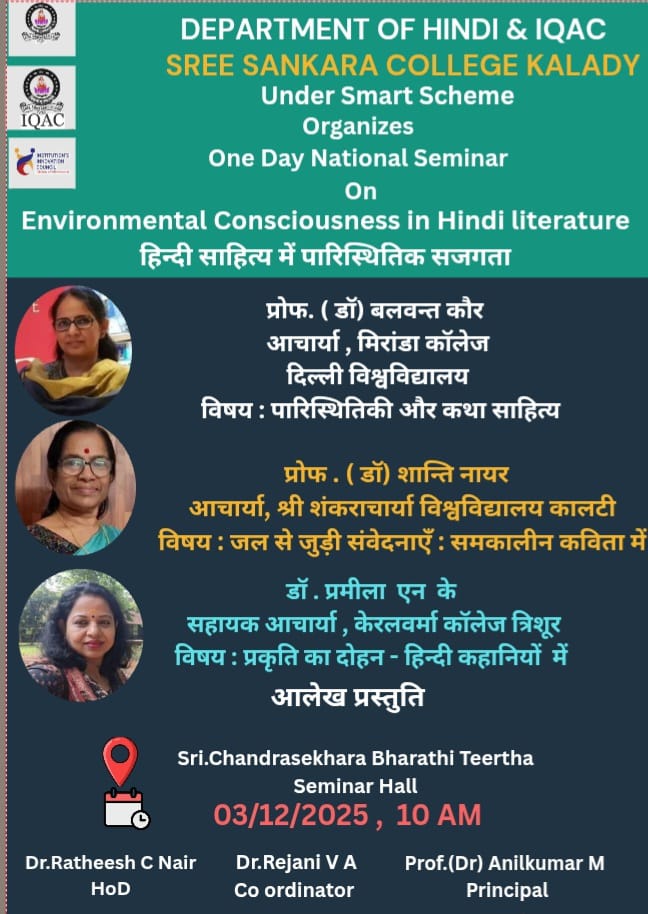
The Department of Hindi in association with IQAC, Sree Sankara College, Kalady, organized a One-Day National Seminar on “Environmental Consciousness in Hindi Literature” (हिन्दी साहित्य में पारिस्थितिक सजगता) under the Smart Scheme on 3 December 2025 at Sri Chandrasekhara Bharathi Teertha Seminar Hall. The seminar aimed to create awareness about ecological concerns reflected in Hindi literature and to promote interdisciplinary discussions on environmental issues.
The programme commenced at 10.00 a.m. with a formal inaugural session attended by faculty members, research scholars, students, and invited guests from various institutions. The seminar was organized under the leadership of Dr. Ratheesh C. Nair, Head of the Department of Hindi, with Dr. Rejani V. A., Coordinator, and the support of Prof. (Dr.) Anilkumar M., Principal.
The first academic session was delivered by Prof. (Dr.) Balwanta Kaur, Acharya, Miranda College, University of Delhi, on the topic “पारिस्थितिकी और कथा साहित्य” (Ecology and Fiction Literature). She highlighted the representation of nature, environmental degradation, and ecological ethics in Hindi fiction and discussed how literary narratives can contribute to environmental awareness and sustainable thinking.
The second session was led by Prof. (Dr.) Shanti Nair, Acharya, Sree Sankaracharya University of Sanskrit, Kalady, who presented a lecture on “जल से जुड़ी संवेदनाएँ : समकालीन कविता में” (Water-related Sensibilities in Contemporary Poetry). She examined the depiction of water as a vital ecological and cultural symbol in contemporary Hindi poetry and emphasized the growing concern over water scarcity and environmental conservation.
The third presentation was made by Dr. Pramila N. K., Assistant Professor, Kerala Varma College, Thrissur, on the topic “प्रकृति का दोहन – हिन्दी कहानियों में” (Exploitation of Nature in Hindi Short Stories). Her paper analyzed how modern Hindi stories portray the exploitation of natural resources and the resulting ecological crises, urging readers to adopt environmentally responsible attitudes.
The seminar witnessed active participation from students, teachers, and research scholars. The interactive discussions following each session provided participants with valuable insights into the relationship between literature and environmental sustainability. The programme successfully highlighted the role of Hindi literature in fostering ecological consciousness and encouraging collective responsibility towards nature.